
At CBD COP17, Building for Forests brought together housing, forestry, science, industry and city perspectives to explore how growing demand for affordable housing could also benefit climate, biodiversity and forest-dependent communities.
Preliminary research presented by Merle Quade and Gerald Steindlegger from IIASA/SITCA examined whether growing demand for construction timber could be met without compromising biodiversity and other forest functions. The contribution highlighted the importance of forest resilience, plantation management, resource availability and safeguards when assessing opportunities to increase sustainable wood supply.
For more information please visit PEFC’s News post.
SITCA at the CBD COP17 in Armenia
Yerevan, 22 October 2026

Towards a Climate Dialogue with the Holy See
Vatican City, 24 September 2026
At a recent audience with Pope Leo XIV, Prof. Hans Joachim Schellnhuber expressed his intention to seek a dedicated discussion with the Holy Father on practical pathways out of the climate crisis.
At this year's Plenary session of the Pontifical Academy of Sciences, Schellnhuber highlighted sustainable timber construction as one of the most promising climate solutions available today, combining carbon storage, emissions reduction, and human well-being. SITCA looks forward to supporting this important dialogue with scientific evidence and practical experience from around the world.

©Vatican media
Waldbauerntag 2026 Highlights the Climate Potential of Sustainable Forestry and Timber Construction
Werl (Germany), 16 September 2026
The Waldbauernverband Nordrhein-Westfalen (WBV NRW) used its annual Waldbauerntag 2026 to call for a stronger integration of climate policy, sustainable forest management, regional wood use, and timber construction. During the event, the association presented the “Declaration of Werl” (German), urging policy-makers to recognize actively managed forests and wood-based construction as essential components of effective climate action.
The declaration emphasizes the crucial role actively managed forests play in climate mitigation by supporting forest adaptation, maintaining high growth rates, and providing renewable raw materials that can substitute more carbon-intensive alternatives. The association argues that climate-resilient forest management and increased use of wood in construction should be supported through research, education, and appropriate regulatory frameworks.
The declaration highlights the significant climate benefits of using timber in construction and calls for barriers to timber construction to be removed. The association also emphasized the role of long-lived wood products in carbon storage and the importance of developing technical and regulatory conditions that enable wider adoption of wood-based building systems.
The event in Werl, Germany featured a keynote by SITCA Co-Founder Professor Hans Joachim Schellnhuber, Director General of IIASA, who stressed the importance of forests and the built environment in addressing climate change. He noted that buildings account for a substantial share of global greenhouse-gas emissions and argued that sustainable forestry combined with a bio-based construction sector (in the so-called forestry-construction-pump) offers a unique opportunity to turn the built environment from a carbon source into a carbon sink.
Is there still a solution to climate change?
Berlin, 8 September 2026
How will our lives change as its impacts become more severe, and what options do we have if current efforts fall short?
IIASA Director General and SITCA Co-Founder Hans Joachim Schellnhuber tackles these questions and shares advice on talking to people who deny climate change in a new YouTube video for the Holz und Klima channel. Watch now (in German)
SITCA Co-Founder Professor Schellnhuber: "This could be the coolest summer of the century"
Vienna, 6 August 2026
As Austria experienced record-breaking temperatures on 4 August 2026, with more than 50 weather stations reporting all-time highs, IIASA Director General and SITCA Co-Founder Professor Hans Joachim Schellnhuber joined Austrian public radio Ö1's Mittagsjournal to discuss what these extremes mean for the future, as well as why society must prepare for a much hotter climate.
Reflecting on the unprecedented heat, Schellnhuber cautioned against viewing the current summer as an isolated event. "This day and this summer may well go down as the coolest of this century," he said, noting that climate projections indicate temperatures as high as 45°C could become commonplace in Vienna within the next two to three decades if global warming continues on its current trajectory.
During the interview, Schellnhuber emphasized that the world has already reached approximately 1.5°C of global warming above pre-industrial levels, which is the first critical threshold identified in the Paris Agreement. While existing national climate commitments would still lead to around 2.7°C of warming by the end of the century if fully implemented, he warned that weakening climate ambitions in many countries makes a rise of around 3°C increasingly likely. Across continental regions, warming could reach approximately 5°C, with cities experiencing temperature increases of up to 8°C.
Schellnhuber stressed that adaptation and mitigation must go hand in hand. While he acknowledged that air conditioning is becoming increasingly necessary, particularly for vulnerable groups and in schools. He cautioned that it cannot be the primary solution. Air conditioning redistributes heat outdoors, intensifying urban heat islands and making public spaces even less comfortable during heat waves. Instead, Schellnhuber highlighted the vital role of nature-based solutions. Expanding urban green spaces, planting trees, and removing impervious surfaces can significantly reduce temperatures in cities. Studies have shown that the temperature difference between densely built-up areas and green, vegetated spaces can reach as much as 20°C, demonstrating the substantial cooling effect of urban nature.
The interview also focused on the role of the built environment in addressing climate change. Schellnhuber argued that replacing carbon-intensive construction materials such as concrete with sustainably sourced timber and other bio-based materials offers a powerful opportunity to reduce emissions while storing carbon. Combined with greener urban design, transforming the construction sector could turn one of today's largest sources of greenhouse gas emissions into a key contributor to climate solutions.
The interview underscores IIASA's commitment to providing science-based insights that help policymakers and society respond to the accelerating impacts of climate change. As extreme heat becomes more frequent across Europe, integrated solutions that combine ambitious emissions reductions with climate-resilient urban planning will be essential to protecting communities and ensuring a livable future.
Successful
Launch of SITCA
Vienna, 1 July 2026
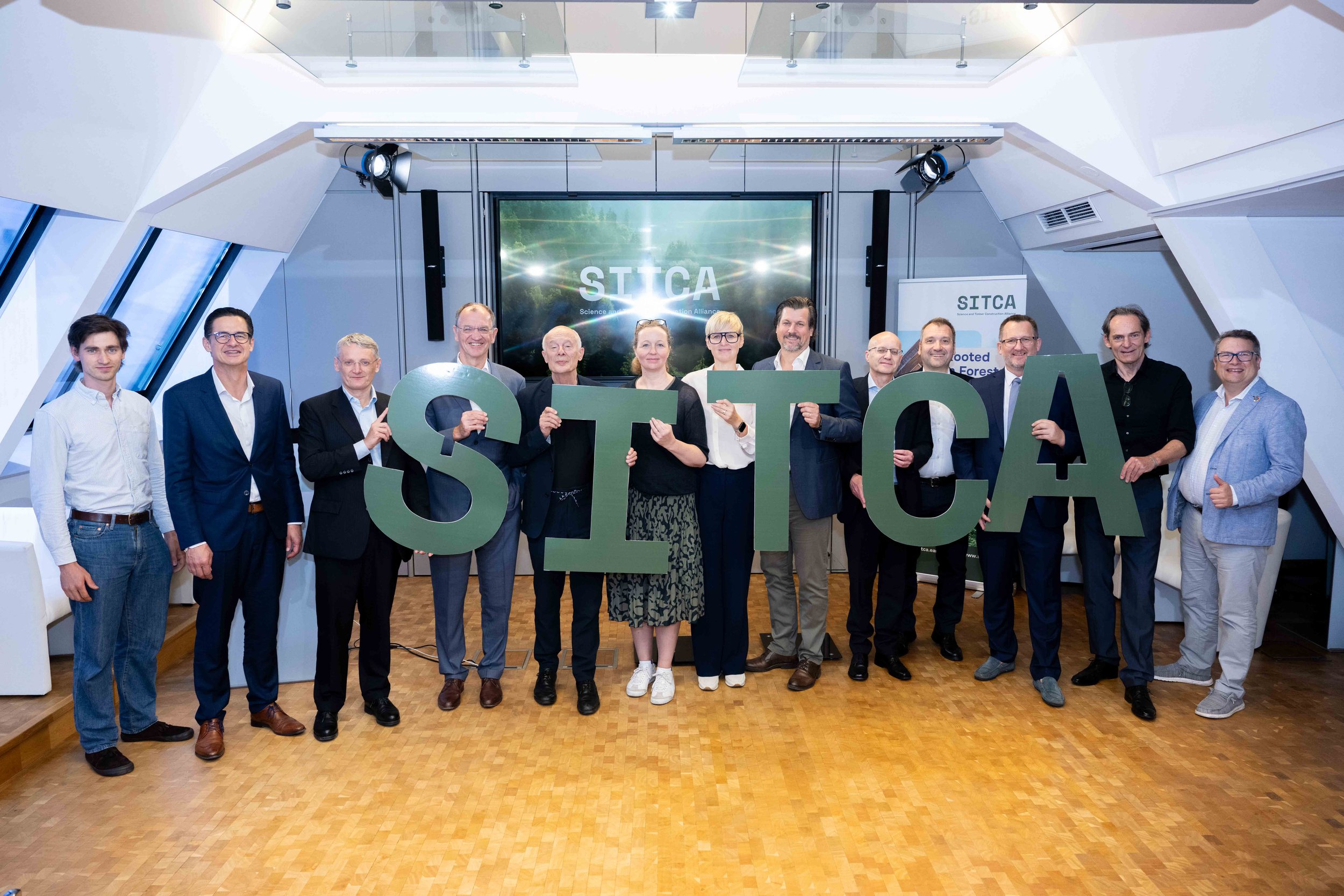
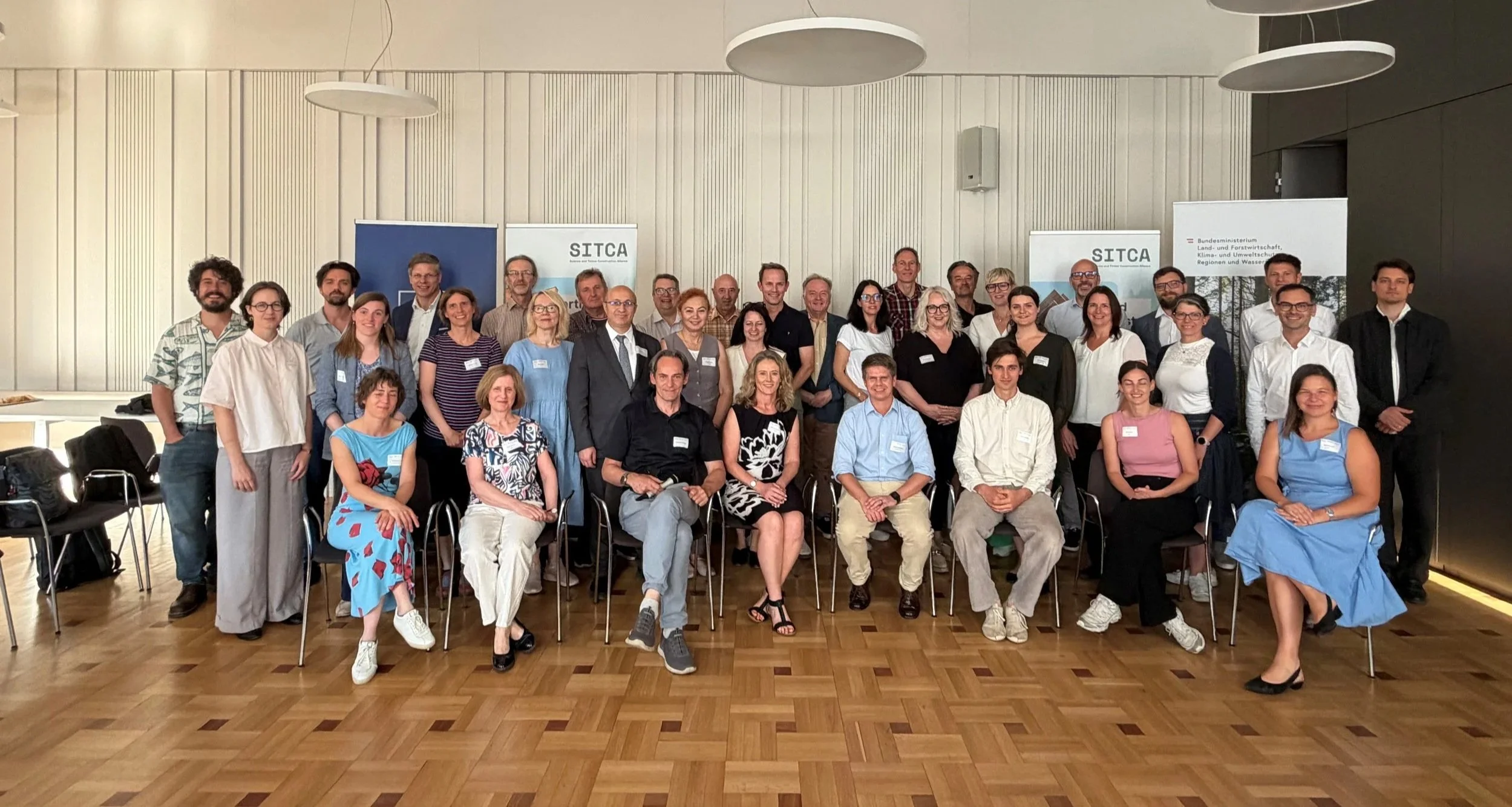
Vienna, 29-30 June 2026
Workshop
From June 29-30, fifty participants from science, industry, communication, policy and NGOs joined a very successful workshop in Vienna
The Goal: Defining the research agenda and communication for sustainable wood solutions in the construction sector
HOST
FAO, Grow the solutions
IIASA & SITCA (Science and Timber Construction Alliance)
BMLUK, the Federal Ministry of Agriculture and Forestry, Climate and Environmental Protection, Regions and Water Management of the Republic of Austria
PLACE and DATE
BMLUK, Stubenring 1, 1030 Wien
Monday 29.6. – Tuesday 30.6.2026
SITCA Co-Founder Professor Schellnhuber highlights concerns over slow progress in decarbonizing the buildings sector
Vienna, 21 May 2026
A recent Table.Briefings article featuring comments by IIASA Director General and SITCA Co-Founder Hans Joachim Schellnhuber highlights growing concerns that progress in decarbonizing the global buildings sector remains too slow to achieve international climate goals. The article discusses findings from the new UNEP and Global Alliance for Buildings and Construction (GlobalABC) Global Status Report for Buildings and Construction 2025/2026.
According to the report, the buildings sector is responsible for 37% of global CO₂ emissions and nearly half of global raw material extraction. While buildings worldwide have become more energy efficient since 2015, construction growth is still outpacing the expansion of renewable energy systems and the rate of building renovation.
The Table.Briefings article notes that the report calls for operational building emissions to be reduced by more than half by 2030 if climate neutrality by 2050 is to remain achievable. It also points to Europe as one of the few regions where building emissions have declined significantly due to stronger efficiency standards and more consistent climate policies.
In comments to Table.Briefings, Schellnhuber emphasized that the report does not sufficiently address the climate potential of biobased construction materials.
“Biobased building materials make it possible to permanently bind CO₂ instead of merely reducing emissions. This represents the greatest untapped opportunity in climate protection,” he noted.
The article also cites calls from climate and construction experts for greater recognition of regenerative and natural construction materials as part of the transition toward climate-neutral buildings.
Read the full UNEP Global Status Report for Buildings and Construction 2025/2026.